
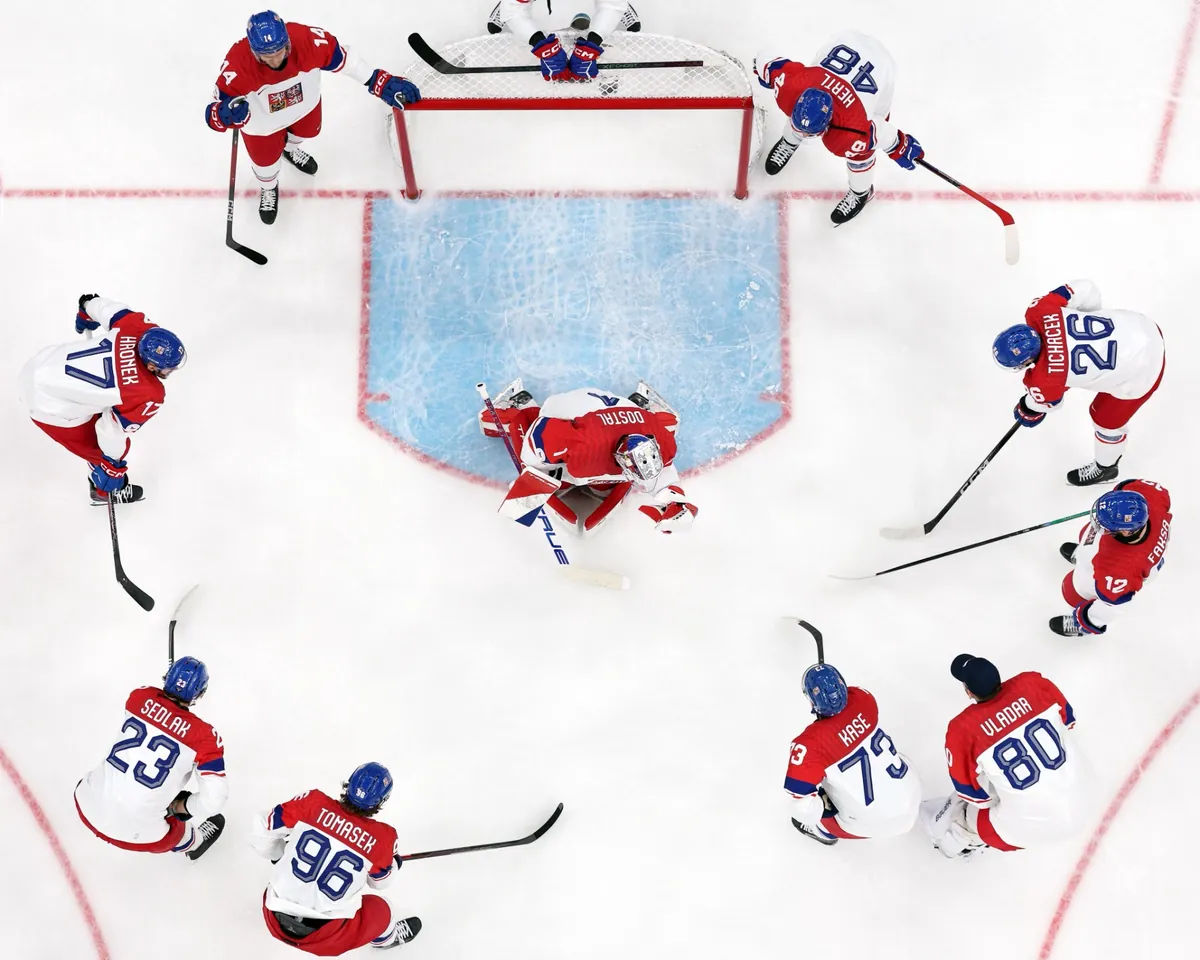
Ice hockey has four positions: center, winger (left and right), defense and goalie. A team plays three forwards, two defensemen and a goalie. In youth hockey and minor hockey, young players should try every position: USA Hockey and Hockey Canada both recommend rotating before kids settle on one.
Here's what each position does in the three zones, what makes it hard, and what to watch from the stands.
What are the positions in ice hockey?
The rink is split by the two blue lines into three zones: the offensive zone (where your team attacks), the neutral zone (the middle) and the defensive zone (in front of your goalie).
| Position | Main job | Hardest part |
|---|---|---|
| Center | Faceoffs, support everywhere | Covers the most ice |
| Winger | Boards, passing lanes, shots | Winning pucks on the wall |
| Defense | Protect the net, start the breakout | Skating backward against speed |
| Goalie | Stop the puck, direct traffic | Every mistake is visible |
What does a center do in hockey?
NHL.com's guide to hockey's positions calls the center role "the most important to the action on the ice." The center takes most faceoffs and plays all 200 feet.
- Offensive zone: supports the puck, often low near the net or behind it, and gets to the slot for rebounds.
- Neutral zone: gives a passing option in the middle of the ice and leads the attack.
- Defensive zone: helps the defensemen down low, near the net and in the corners. Many young centers drift high waiting for a breakout pass; the center is usually the forward expected to come back deepest.
What makes it hard: the most skating, and the most reading. A center has to know where the puck is going before it gets there. Faceoffs add a skill of their own: see faceoff rules and positioning.
What does a winger do in hockey?
Wingers play on either side of the center, the left winger on the left side, the right winger on the right.
- Offensive zone: NHL.com describes wingers working the corners to win pucks and pass them back or across, and screening the goalie in front of the net.
- Neutral zone: stay in their lane, wide, to stretch the other team.
- Defensive zone: cover the opposing defensemen at the points, block shots and get to the boards for the breakout pass.
What makes it hard: the breakout pass on the boards. The winger often receives the puck with their back to the play and an opponent closing in. Getting the puck out of the zone is a winger's most important job, and the least visible.
What does a defenseman do in hockey?
Defensemen play in pairs, one on the left and one on the right.
- Defensive zone: NHL.com lists their jobs as stopping passes, winning the puck, moving it out of the zone and clearing players and rebounds from the front of the net.
- Neutral zone: move the puck to the forwards, often with cross-ice passes, and stay between the attackers and their own net.
- Offensive zone: hold the blue line at the points, shoot, and keep the puck in the zone. When one defenseman joins the attack, the partner stays back.
USA Hockey's ADM notes that defensemen no longer stay strictly in their lanes (ADM Kids, 2019): a modern defenseman skates, carries the puck and joins the play.
What makes it hard: skating backward against a player coming at full speed, and making the first pass under pressure. A defenseman's mistake often ends up in the net.
What does a goalie do in hockey?
NHL.com describes the goalie's main job as keeping the puck out of the net, controlling rebounds, freezing or passing the puck, and talking to teammates about threats around the net.
- Defensive zone: square to the shooter, controls rebounds, calls out open players ("man on," "time").
- Neutral and offensive zones: follows the play, stops dump-ins behind the net and sets the puck up for a defenseman.
What makes it hard: goalies may face few shots for long stretches, then one breakaway decides the game. The position is technical and the mistakes are public.
Which hockey position should my kid play first?
All of them. The national bodies are clear on this.
- Hockey Canada, U9 (8U/Mite): "All players play all positions," with "no full-time goaltenders" (U9 Player Pathway).
- Hockey Canada, U11 (10U/Squirt): "Players should play all positions," with full-time goaltenders now allowed (U11 Player Pathway). Its goaltending pathway asks associations to offer "Try Goaltending" sessions to avoid specializing early.
- USA Hockey, 6U and 8U: ADM regional manager Roger Grillo says young players should try "every position on the ice," and that at 8U there shouldn't be any position beyond goalie (ADM Kids, 2021).
- USA Hockey, 10U: "It's impossible to look at a 9- or 10-year-old player and know" which position will suit them, writes Guy Gosselin (ADM Kids, 2023). Bob Mancini suggests practices where players switch positions "every other repetition" (ADM Kids, 2018).
What about goalie?
USA Hockey's ADM puts the best age to become a full-time goalie at 12 or 13, and says players shouldn't be backup goalies before 13: teams can rotate goalies instead (Phil Osaer, ADM Kids, 2017). A young kid who loves goalie can focus on it, as long as teammates who want to try still get a turn. For 10U teams with two goalies, Mancini suggests letting one play out while the other is in net, or rotating midway through each period.
Gustavus Adolphus coach Mike Carroll sums up the forward-defense question: "Don't pick positions for young players. Let them learn them all" (ADM Kids, 2020).
How to watch your kid's position from the stands
Most parents watch the puck. Try watching your kid without the puck for one shift:
- Center: after a turnover, does your kid come back below the puck, or stay high waiting for a pass?
- Winger: in the defensive zone, are they on the boards ready for the breakout pass, or drifting to the middle?
- Defense: when the other team rushes, is your kid between the puck carrier and the net?
- Goalie: after a save, where does the rebound go? Are they talking?
Ask one question on the drive home, not ten: "What did you see when you were on defense?" Kids who rotate learn to answer it from every position.
Coach's note: Positioning without the puck is hard to explain on a whiteboard and easy to show on video. With Taggley, a coach can draw on a clip while recording a voiceover, showing a winger where to stand on the breakout, and send it to that player, their line or the team. Every coach, player and parent gets a free account with drills and PDFs, plus one free game of video per team.
Frequently asked questions
How many players are on the ice in hockey?
Six per team at full strength: three forwards (a center and two wingers), two defensemen and a goalie. A penalty takes one skater off: see hockey penalties explained.
What is the easiest hockey position for a beginner?
None is easy, and that's why young players rotate. Each position teaches something the others need.
When should a kid pick a position?
Hockey Canada wants all players playing all positions at U9 and U11. USA Hockey's ADM puts full-time goaltending at 12 or 13.
What does a center do in hockey?
Takes most faceoffs, supports the puck in all three zones and comes back deepest of the forwards on defense.
Sources
- NHL.com, "Hockey's Positions" (Bob Condor, August 31, 2022)
- Hockey Canada, Canadian Player Pathway: U9 Hockey (abridged)
- Hockey Canada, Canadian Player Pathway: U11 Hockey (abridged)
- Hockey Canada, Canadian Goaltending Pathway (2022-23)
- USA Hockey ADM, "6U/8U: Player Positions and Learning the Game" (Michael Rand, December 16, 2021)
- USA Hockey ADM, "Positions at 10U: The good, the bad, and the bubble hockey" (Michael Rand, October 16, 2018)
- USA Hockey ADM, "10U Q-and-A: Positional Versatility" (Guy Gosselin, January 25, 2023)
- USA Hockey ADM, "10U Q-and-A: When is the time for full-time?" (Phil Osaer, October 16, 2017)
- USA Hockey ADM, "12U: College Coaches on Positional Versatility" (Shane Frederick, January 23, 2020)
- USA Hockey ADM, "12U: Building attack-minded, position-less players" (Michael Rand, January 17, 2019)