
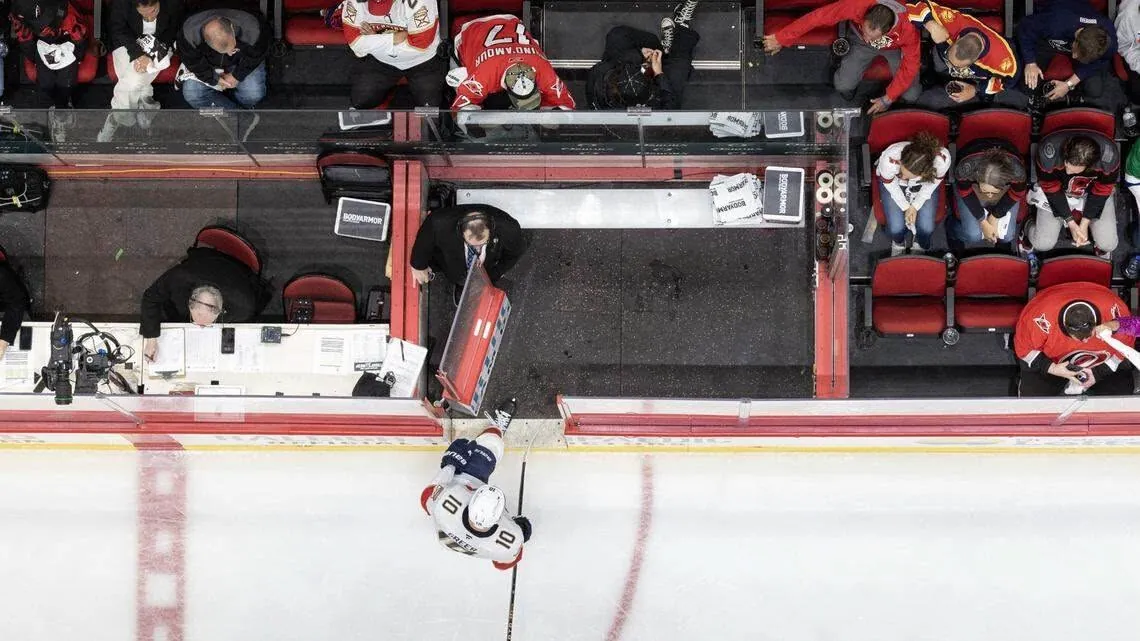
Hockey penalties send a player to the penalty bench, leaving their team a skater short. Cross-checking, slashing, hooking and tripping are stick and body fouls, usually two-minute minors; boarding targets a defenseless player. In youth hockey and minor hockey, these calls protect players and create most power plays.
This guide uses the definitions and referee signals from Hockey Canada's 2024-2026 playing rules, with the IIHF rule book and USA Hockey's rules where they add detail.
Minor vs major penalty: what's the difference?
- Minor: two minutes of playing time on the penalty bench (Hockey Canada Rule 4.2). The goalie never serves it; a teammate does.
- Major: five minutes (Rule 4.4). In Hockey Canada, "any player assessed a Major penalty will also be assessed a Game Misconduct": the player is done for the game.
- Match: five minutes plus removal from the game, for the most serious fouls.
Hockey Canada's minor and female minimum suspension guidelines (June 2026) add a suspension on top: at least one game for a major in boarding, cross-checking, slashing or roughing (two games if it happens in the last 10 minutes), and at least three games for a match penalty.
When you see a referee raise one arm straight up, that's the delayed penalty signal: a call is coming once the whistle blows.
What is cross-checking in hockey?
Definition. Hockey Canada: a player "uses the shaft of the stick, between the two hands, to check an opponent." USA Hockey's 2025-29 rules put it the same way: no using the shaft between the hands "to forcefully check an opponent."
Minor vs major. Usually a minor. Hockey Canada's suspension guidelines list both a major (Rule 9.2(b)) and a match penalty (9.2(c)). The IIHF allows a major plus game misconduct when the player "recklessly endangers" the opponent (Rule 59.3).
Referee signal. Both fists clenched, arms pushed forward and back, as if shoving with a stick.
Where you'll see it. In front of the net, when a defenseman clears a forward with the stick instead of the body.
What is slashing in hockey?
Definition. Hockey Canada: a player "hits an opponent with a stick," held in one or both hands. The IIHF adds that it counts whether or not the stick makes contact, and that a light tap on the pants or front of the shin pads shouldn't be called (Rule 61.1).
Minor vs major. Usually a minor, judged on force. Hockey Canada's suspension guidelines list a major (9.3(b)) and a match penalty (9.3(c)).
Referee signal. A chopping motion with the edge of one hand across the opposite forearm.
Where you'll see it. A chop on the hands or gloves of a puck carrier. Hands and wrists have little padding, which is why officials watch it closely.
What is hooking in hockey?
Definition. Hockey Canada: using the blade of the stick in a "pulling or tugging" motion. The IIHF says contact on or near the opponent's hands is penalized, but stick-on-stick contact during a check isn't (Rule 55.1).
Minor vs major. Almost always a minor. The IIHF allows a major plus game misconduct if the hook recklessly endangers the player (Rule 55.3).
Referee signal. Both arms make a tugging motion, as if pulling something toward the stomach.
Where you'll see it. A player beaten on a rush who reaches with the stick instead of moving their feet. For coaches, a hooking call is usually a skating problem, not a discipline problem.
What is tripping in hockey?
Definition. Hockey Canada: a player places a stick or body in a way that "causes an opposing player to trip or fall." The IIHF doesn't penalize an accidental trip that happens with a completed play or at a stoppage (Rule 57.1).
Minor vs major. Usually a minor. The IIHF allows a major when the trip recklessly endangers the player, and a major plus game misconduct when a major alone isn't enough (Rules 57.3 and 57.4).
Referee signal. The official strikes their leg below the knee with one hand, both skates on the ice.
Where you'll see it. A sweep at the puck that takes the skates instead.
What is boarding in hockey?
Definition. Hockey Canada: a player "checks or pushes a defenseless or unsuspecting opponent" into the boards. The IIHF adds that the checker must avoid or minimize contact with a defenseless player (Rule 41.1).
Minor vs major. The IIHF sets the penalty by the force of the impact (Rule 41.2). Hockey Canada's suspension guidelines list a major (7.2(b)) and a match penalty (7.2(c)).
Referee signal. A clenched fist struck into the open palm of the other hand, in front of the chest.
Why it matters. A player facing the boards can't brace. Boarding applies at every age, including in non-checking leagues, because a push from behind is enough.
High-sticking and roughing
High-sticking. Hockey Canada: carrying the stick above "the normal height of the shoulders." The IIHF calls a minor for stick contact above the shoulders and a double minor (four minutes) when it causes an injury, such as bleeding (Rules 60.2 and 60.3). Signal: both fists clenched, one above the other, at forehead height.
Roughing. Hockey Canada: "unnecessary rough play." Hockey Canada's suspension guidelines list a major (7.9(b)) and a match penalty (7.9(c)). Signal: a clenched fist, arm extended to the front or side.
Why these penalties matter in youth hockey: body checking age rules
- Hockey Canada removed body checking from Peewee and below starting in 2013-14, according to its 2013 AGM announcement. Its checking progression page says full body checking isn't permitted until U15 (14U/Bantam) at most intermediate and competitive levels, and that some house leagues offer a non-checking option at U15 and U18 (18U/Midget).
- USA Hockey doesn't allow body checking "until the 14U level," according to ADM Kids (July 2022). Younger players learn "competitive contact": angling and body position to win the puck.
The research backs this up. A University of Calgary study in the British Journal of Sports Medicine found that banning body checking in non-elite Bantam (13 to 14 years old) cut injury rates by 56 per cent (University of Calgary, 2019).
So at U13 (12U/Peewee) and below, a hit that sends a player into the boards isn't "playing hard": it's a penalty. Parents who know that are calmer in the stands and better at explaining the call at home.
How penalties create power plays
Every penalty puts the other team on a power play and yours on a penalty kill:
- One minor: 5-on-4 for two minutes. If the team on the power play scores, the minor with the least time left ends (Hockey Canada Rule 4.2).
- Two minors at once: 5-on-3.
- Coincidental penalties (equal penalties to both teams at the same stoppage): neither team plays short (Rule 4.5).
How each side plays those two minutes is its own topic: see what is a power play in hockey and what is a penalty kill in hockey.
Coach's note: A team that takes the same hooking or tripping minor every game usually has a skating or positioning habit behind it. Taggley's AI cuts every power play and penalty kill in a game in under 40 minutes, so a coach can see what led to each one and teach it with a voiceover. For a routine, see how to review power plays and penalty kills on video.
Frequently asked questions
How long is a minor penalty in hockey?
Two minutes of playing time. It ends early if the other team scores on the power play.
Is a major penalty an ejection?
In Hockey Canada, yes: a major automatically comes with a game misconduct (Rule 4.4), and the minimum suspension guidelines add at least one game for majors like boarding or cross-checking.
What's the difference between slashing and hooking?
Slashing is hitting a player with the stick. Hooking is pulling or tugging a player with the blade to slow them down.
At what age is body checking allowed?
At U15 (14U/Bantam): Hockey Canada at most intermediate and competitive levels, USA Hockey from 14U. Some house leagues stay non-checking longer.
Sources
- Hockey Canada, Playing Rules 2024-2026: Referee's Signals, Glossary, Rules 4.2, 4.4, 4.5.
- Hockey Canada, Minor / Female Minimum Suspension Guidelines (June 2026)
- IIHF Official Rule Book 2023/24 (Finnish Ice Hockey Association digital edition): Rules 41, 55, 57, 59, 60, 61.
- USA Hockey, 2025-29 Playing Rules and Casebook
- Hockey Canada, "94th Annual General Meeting concludes in Charlottetown" (May 2013)
- Hockey Canada, Checking (NCCP checking model)
- USA Hockey ADM, "12U: Coaching Competitive Contact" (Michael Rand, July 20, 2022)
- University of Calgary, "Ban on bodychecking in non-elite Bantam ice hockey significantly reduces injury" (Stacy McGuire, November 13, 2019)