
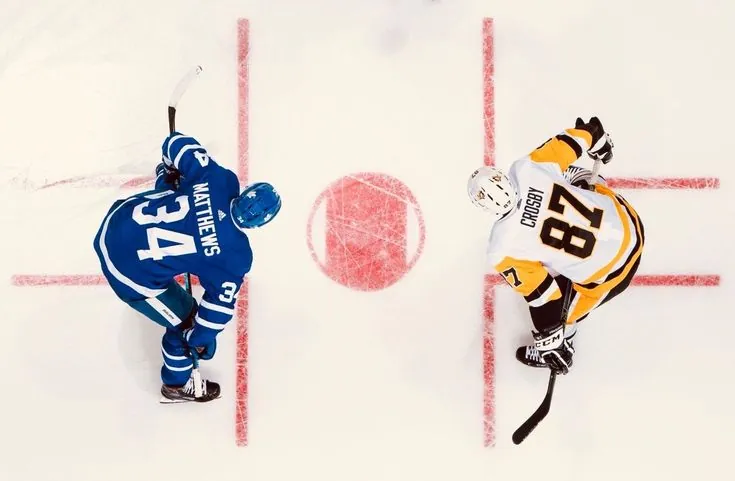
A faceoff in hockey is how play starts or restarts: an official drops the puck between the sticks of two players, usually the centers, and each tries to win it back to a teammate. In youth hockey and minor hockey, a team takes dozens of faceoffs a game, and winning the important ones decides possession in your own zone.
This guide covers the faceoff rules from Hockey Canada's 2024-2026 playing rules, where faceoffs happen, how the other four players line up, and how centers win more draws.
Faceoff rules: who lines up where
Under Hockey Canada's Rule 6.2:
- The two players taking the faceoff stand squarely facing the opponent's end, about one stick length apart, with the blades of their sticks flat on the ice.
- Everyone else must stand at least 15 feet (4.57 m) from the players taking the faceoff, and on-side.
- On an end-zone faceoff, the other players must stay outside the faceoff circle and clear of the restraining lines (the hash marks). Hockey Canada's glossary allows a stick inside the circle, but not between the hash marks.
- The visiting team's center puts their stick down first. On end-zone faceoffs, the attacking team takes its positions first, and the defending team sets up after.
- No goalie can take a faceoff (Rule 6.2(b)).
- The faceoff is complete when the puck has been legally dropped and touches the ice.
Why do centers get thrown out of faceoffs?
Under Rule 6.2(a) and (d), the center is removed and replaced when their team commits a faceoff violation, including when:
- the center doesn't line up properly or moves early;
- another player on their team moves off-side, makes contact with an opponent, or enters the circle before the drop (encroachment).
Any other player except the goalie can then take the draw. If a teammate encroached, the official identifies that player, who can't take the replacement faceoff.
A second violation by the same team on the same faceoff can bring a minor penalty for delay of game (Rule 6.2(e)). And after the faceoff, a player can't make physical contact with the opponent's body or stick except while playing the puck; that's a minor penalty (Rule 6.2(c)).
Where do faceoffs happen?
There are nine faceoff spots: one at center ice, the neutral-zone spots near each blue line, and two in each end zone. Hockey Canada's Rule 6.3 decides which one is used:
| Situation | Where the faceoff goes |
|---|---|
| Start of a period, after a goal | Center ice |
| Icing | End-zone dot of the team that iced it, on the side nearest to where it was shot |
| Penalty | One of the two end-zone dots in the penalized team's defending zone (with exceptions, such as after a goal or at the end of a period: center ice) |
| Off-side | Neutral-zone dot nearest the attacking zone of the offending team |
| Intentional off-side | End-zone dot of the offending team |
| Puck out of play or frozen in an end zone | Nearest dot in that end zone |
| Stoppage caused by neither team | Nearest faceoff spot, excluding center ice |
Interpretation 5 of Rule 6.3 adds a detail parents often miss: which end-zone dot is used depends on the side of the ice where the puck was shot, or where the goalie froze it.
In junior and senior hockey, the attacking team can choose the end-zone dot after an icing or a penalty (Rule 6.4(b)).
Winger and defense positioning on a faceoff
Every faceoff is a five-player play, not a one-on-one between centers.
Defensive zone. Each player has a direct assignment:
- The wingers line up on the hash marks and take the opposing wingers, or the opposing defense at the points if the puck is won back.
- The board-side defenseman handles the winger coming off the wall. Former NHL coach Don Nachbaur, on NHL.com, describes this as the key job against set plays.
- The other defenseman protects the front of the net. Nachbaur calls the area from the goal posts to the faceoff dots and the tops of the circles "The House." Nobody leaves it open.
Offensive zone. The goal is the reverse: get the puck back to a shooter and get traffic to the net. Nachbaur says some pro teams have "more than 10 set plays off a win." At minor hockey, one or two is enough: a pull back to the defenseman for a quick shot, with both wingers driving the net.
Neutral zone. Win it back to the defense and start the breakout, or push it forward and attack.
How to win more faceoffs
Dan Jablonic of USA Hockey's American Development Model, in an ADM Kids article on winning the draw, and Nate Leslie of Leslie Global Sports give the same fundamentals:
- Stance. "Everything starts from the hockey ready position," Jablonic says: knees bent, low and balanced. Leslie: "Get wide and low."
- Watch the hand, not the puck. Officials drop the puck differently, so watch the official's hand and move with it.
- Grip. Hold the stick normally, or turn the top hand over for more power on a backhand pull. Leslie notes that turning the hand over shows the other center where you're going.
- Use the body. Turn with the hips and the inside edges to pull the draw to your forehand or backhand. Leslie adds pressing down and cutting back with the edge of the blade.
- Talk before the draw. Jablonic calls the center "the commander": tell the wingers if you're pulling it back or pushing it forward.
- Lose well. A lost draw is fine if the center gets a stick on the puck and the wingers jump in. Jablonic encourages letting players be creative.
Shaun Earl writes on The Coaches Site that faceoffs "aren't practiced, taught, or emphasized nearly enough" in youth hockey. He suggests teaching every player five questions: what's the objective of this draw, where does the puck go, what's my first stride and stick angle, what do I do if we win, and what do I do if we lose.
Three faceoff drills
1. Faceoff intensity game
From USA Hockey's ADM: six players line up as on a real faceoff, and the coach drops the puck. The losing team's wingers have to leave the ice, creating a 3-on-1 for the winners. Wingers crash the dot on the drop. Coaching point: it makes faceoffs a team battle, not a center's job.
2. Watch the hand
Two centers, a coach dropping pucks with changing rhythms: quick, slow, fake. Coaching point: react to the hand, not the voice or the count.
3. Win and execute
Center, two wingers and one defenseman against the same on the other side. The center calls the play, wins the draw and the unit runs it to a shot. Coaching point: the faceoff isn't over until the team has possession.
Coach's note: Faceoff technique is almost impossible to see live: the draw takes a second, and the bench is far from the dot. Taggley's AI cuts every faceoff in a game in under 40 minutes, so a coach can review a center's technique on 20 draws in a couple of minutes: stance, hand, which side they lose on.
Frequently asked questions
Who takes a faceoff in hockey?
Usually the centers, but any player except the goalie can take one. If a center is thrown out for a violation, a teammate takes it.
What is a faceoff violation?
Lining up wrong, moving early, or a teammate entering the circle or moving off-side before the drop. The center is removed and replaced; a second violation on the same faceoff can bring a delay-of-game penalty.
Where is the faceoff after a penalty?
In Hockey Canada, in the penalized team's defending zone, with exceptions: after a goal or at the end of a period, it's at center ice.
How many faceoff spots are there in hockey?
Nine: one at center ice, the neutral-zone spots near each blue line, and two in each end zone.
Sources
- Hockey Canada, Playing Rules 2024-2026: Rules 6.2 (Face-off Conduct), 6.3 (Face-off Location), 6.4 (Junior & Senior), glossary.
- USA Hockey ADM, "12U: Winning the Draw" (Michael Rand, February 7, 2020)
- USA Hockey ADM, "12U+: Faceoff Intensity Game" (October 19, 2022)
- NHL.com, former NHL coach Don Nachbaur on faceoff strategy
- Nate Leslie, "How to take a Faceoff" (Leslie Global Sports, July 3, 2019)
- Shaun Earl, "Battle of The Dot" (The Coaches Site)