
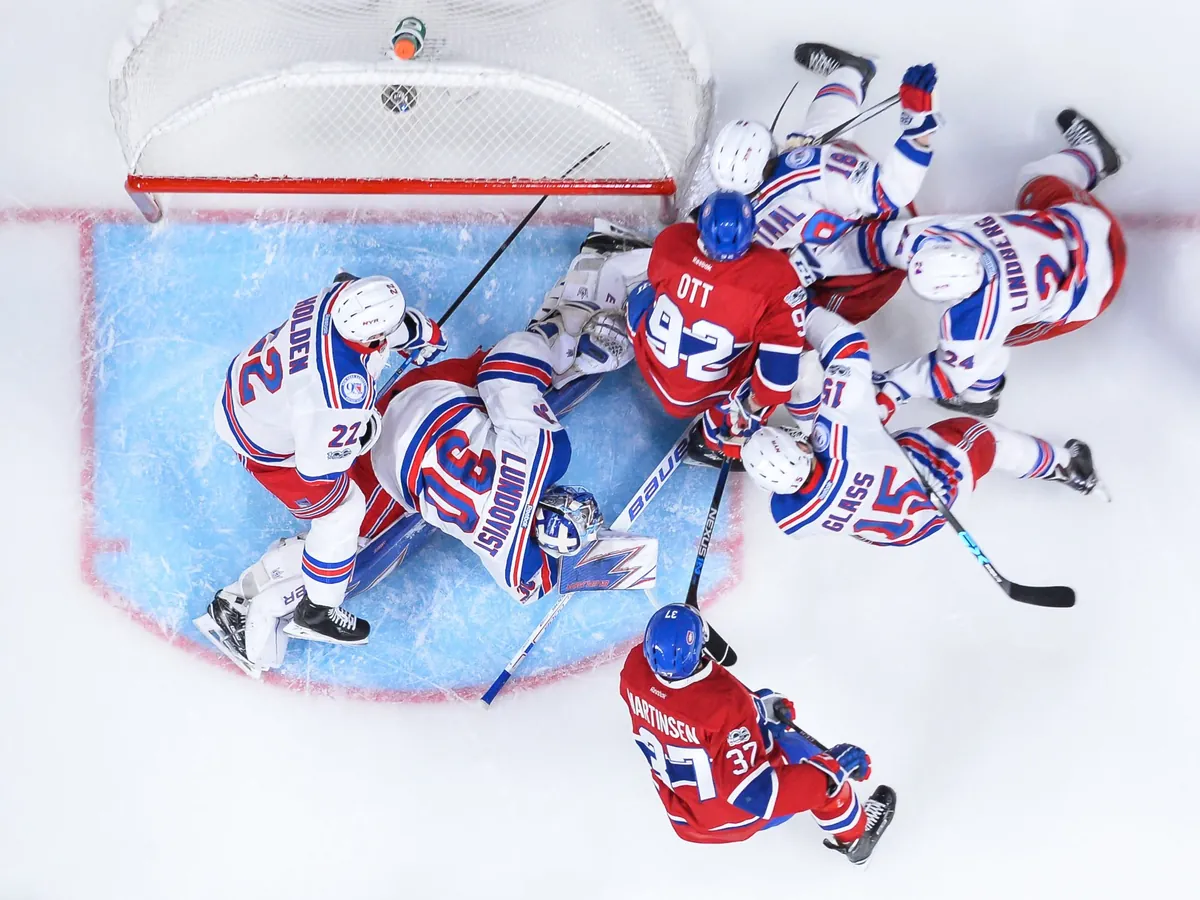
The best hockey drills for defensemen train four habits: gap control, puck retrievals, the first pass and net-front defending. Below are 10 drills youth hockey coaches can run on half ice or less, each with a setup, one coaching point and the minor hockey ages it fits.
The drills start from what Hockey Canada and USA Hockey say a defenseman needs, one drill per habit, so you can pick the two or three that fix last weekend's problem.
What makes a minor hockey defenseman develop?
Hockey Canada's Developing Skilled Defencemen (2020-21) builds the position on skating first: backward stride, backward starts and stops, forward-backward transitions and lateral movement. On top of that come four habits, each with a short cue:
- Gap control: "stay up, don't step up." Hold a tight gap in the neutral zone without lunging at the puck carrier.
- Retrievals: shoulder check, take an angle, use deception, then explode to the puck to create time.
- The first pass: hard, flat and accurate, with the decision made before touching the puck.
- The net front: box out, face the puck, control your stick and don't get tied up.
Two coaching voices add to that. Kelvin Cech of The Coaches Site calls scanning before a retrieval "a defenceman's most important function". Former NHL development coach Craig Johnson, writing for NHL.com, describes defensemen who take "multiple head checks" before a puck arrives along the wall. The drills below cover all four, plus angling, 1-on-1 play and point shots.
At what age should kids play defense?
Hockey Canada recommends no position specialization until U13: every player plays every position through U11. So at U9 (8U/Mite) and U11 (10U/Squirt), run these drills with the whole team, forwards included. Hockey Canada also suggests a beginner's season is about 75% technical skills, 20% individual tactics and 5% team tactics, and that each skill is taught in three steps: skating first, then add the puck, then add a teammate or opponent. Drills 1, 3 and 7 fit that first step. The breakout and 2-on-2 drills belong to U13 (12U/Peewee) and up.
1. Mirror lanes
Setup:
- Mark lanes about 10 feet wide with pylons, from the blue line to the goal line; one attacker faces one defender in each lane, a stick length apart.
- The attacker skates forward at half speed, cutting left and right inside the lane; the defender skates backward and mirrors.
- Three reps without a puck, then the attacker carries one; switch roles every rep.
Coaching point: Turn with a Mohawk pivot (open the hips, heels toward each other) instead of crossing the feet, so the chest stays square to the attacker.
Ages: U9 (8U/Mite) and up. Hockey Canada uses the same lane idea in its U9 practice plans under "Checking: Gap Control."
2. Gap control chase
Setup:
- Defender at the goal post, attacker at the blue line with a puck, one pylon at the top of each circle.
- On the whistle, the attacker circles either pylon and attacks the net; the defender sprints up the slot to close the space before the attacker turns.
- Play 1-on-1 until a shot, a whistle or the defender clears the puck to a coach at the blue line.
Coaching point: Close with your feet and arrive stick first. USA Hockey's Grillo Gap Drill, the model for this one, warns that the defender "does not stand still or skate backward" while closing.
Ages: U11 (10U/Squirt) and up. The ADM lists the Grillo drill for 10U to 18U.
3. Angle and ride
Setup:
- A coach dumps a puck into the corner; an attacker starts at the goal line, the defender at the far post.
- The attacker picks it up and tries to skate it up the boards to the blue line, first at half speed, then full speed.
- The defender comes out of the slot on an angle, stick on the ice, and steers the attacker into the boards, riding them to the blue line.
Coaching point: Take away the middle first. USA Hockey's Mike Doyle describes angling as forcing the attacker from good ice to bad ice, with "your stick on the puck" at the contact point.
Ages: U9 (8U/Mite) and up. At U9 and U11, finish with the stick on the puck, not the body.
4. Corner contain 1-on-1
Setup:
- Attacker and defender start shoulder to shoulder at the top of the circle; the coach shoots a puck into the corner.
- Both race for it. The attacker tries to reach the net; the defender keeps them below the goal line and outside the dots.
- 20-second shifts. The defender earns a point by moving the puck to the coach at the blue line.
Coaching point: Win the first steps. Dave Cameron writes in Elite Hockey Defense that winning the first 6 to 8 feet of a puck race, and getting in front, often decides it.
Ages: U11 (10U/Squirt) and up.
5. 2-on-1 net-front battle
Setup:
- Two attackers and one defender in front of the net, a goalie, and a coach with pucks at the point.
- The coach shoots low; the attackers screen, tip and chase rebounds while the defender boxes out.
- Live for 20 to 30 seconds, or until a goal, a freeze or a clear to the coach.
Coaching point: Box out, face the puck and control the most dangerous stick, the one that can reach the rebound.
Ages: U13 (12U/Peewee) and up. For U11, run it 1-on-1 like USA Hockey's 1v1 Puck Battle With Net-Front Tip, listed for 10U to 12U.
6. Scan-and-go retrieval
Setup:
- Defender at the top of the circle; a coach rims a puck around the boards or shoots it into the corner.
- As the defender turns back, a second coach behind the net raises a stick on the left or right to show pressure.
- The defender shoulder checks twice before reaching the puck and goes away from pressure: up the wall, wheel behind the net or rim it.
Coaching point: Know the play before you touch the puck. Hockey Canada's Coach 2 team play package puts it as "Check your shoulder for pressure and outlet."
Ages: U11 (10U/Squirt) and up. At U13 and up, replace the coach with a live forechecker.
7. First-pass bullseye
Setup:
- Pucks in both corners; a forward on each half-wall, circling at the hash marks; the defender in front of the net.
- The defender skates to a corner, picks up a puck and passes to the forward moving up the wall.
- The forward skates it out around a pylon at the blue line; the defender returns to the net front. Six reps per side.
Coaching point: The pass is hard and flat, on the forward's stick, and decided before the defender touches the puck.
Ages: U9 (8U/Mite) and up. At U9, shorten the pass: Hockey Canada's U9 player pathway notes that passes of 5 to 10 feet improve accuracy and receiving.
8. D-to-D breakout
Setup:
- Two defenders at the top of the circles, a forward on each half-wall; the coach dumps a puck behind the net.
- D1 retrieves; D2 slides to the far post and calls "over"; D1 passes D-to-D and D2 hits the weak-side forward.
- Progression: add a forechecker, and let D2 call "reverse" so D1 wheels and sends the puck back off the boards.
Coaching point: D2 stays lateral to or below the partner, stick on the ice, and makes the call before D1 reaches the puck, as Hockey Canada's Coach 2 package teaches.
Ages: U11 (10U/Squirt) without a forechecker; U13 (12U/Peewee) and up with one.
9. Walk the line and shoot
Setup:
- Defender at the point, a coach on the half-wall with pucks, a forward screening at the net front.
- The coach passes; the defender walks laterally along the blue line two or three strides to open a lane and shoots low.
- The forward tips or chases the rebound. Alternate sides.
Coaching point: Shoot for sticks and rebounds, not corners. A low shot that reaches the net front is worth more than a hard one that hits the first shin pad.
Ages: U11 (10U/Squirt) and up.
10. 2-on-2 regroup gap
Setup:
- Two defenders on the blue line, two forwards at the red line, a coach at center with pucks.
- The coach passes to a defender, who passes D-to-D; the partner hits a forward swinging through the neutral zone, and both forwards attack 2-on-2.
- The defenders close the gap off their own pass and play to a shot or a whistle.
Coaching point: Step up together. The puck-side defender takes the carrier and the partner covers the middle and far side, the split Hockey Canada's Coach 2 package uses in the neutral zone.
Ages: U13 (12U/Peewee) and up. At U11, play it 2-on-1 with one defender.
Download the 10 drills as a practice PDF
Every drill fits on half ice or less, so two can run at once. Build them in Taggley's drill creator, drop them into a practice plan and download the plan as a PDF for your assistant coaches. Both come with the free account, which every coach, player and parent can open at taggley.com. The free tools are free for drills and PDFs, plus one free game of video per team. For the youngest players, the companion page on half-ice drills for U9 and U11 shows how to run stations on shared ice.
Coach's note: Defensemen improve faster once they see their own gaps. Taggley's AI cuts every goal from a full game, goals against included, in under 40 minutes, and the coach chooses which ones to show a pair and asks one question: "Where was your gap?" For the full review routine, see how to break down hockey game film in 15 minutes; for defensemen on special teams, read what is a penalty kill in hockey.
Frequently asked questions
What is gap control in hockey?
The space between a defenseman and the attacking forward. USA Hockey's Mike Doyle quotes Seth Appert: a good gap "starts with your defensemen never standing still" on the offensive blue line.
At what age should a player become a full-time defenseman?
Hockey Canada recommends no specialization until U13 (12U/Peewee). Through U11, every player rotates through every position, including defense.
Sources
- Hockey Canada, Developing Skilled Defencemen (Development Programs, 2020-21)
- Hockey Canada, Developing Skilled Defencemen (Development Programs, 2018-19)
- Hockey Canada, Coach 2 Team Play Package (hosted by BC Hockey)
- Hockey Canada, U9 Program Practice Plan 28
- Hockey Canada, Canadian Player Pathway: U9 Hockey
- USA Hockey ADM, "10U-18U: Grillo Gap Drill" (December 5, 2016)
- USA Hockey ADM, "10U-12U: 1v1 Puck Battle With Net-Front Tip" (February 28, 2019)
- USA Hockey, "Winning in Transition: Angling, Gaps and Creating Turnovers in Today's Game" (Mike Doyle, February 1, 2019)
- Kelvin Cech, "The most important skill a defenceman will ever learn" (The Coaches Site, 2026)
- Craig Johnson, "Effective play along wall essential in today's NHL" (NHL.com, November 12, 2024)
- Dave Cameron, "Closing, Controlling, and Creating Space," Elite Hockey Defense (Human Kinetics)