
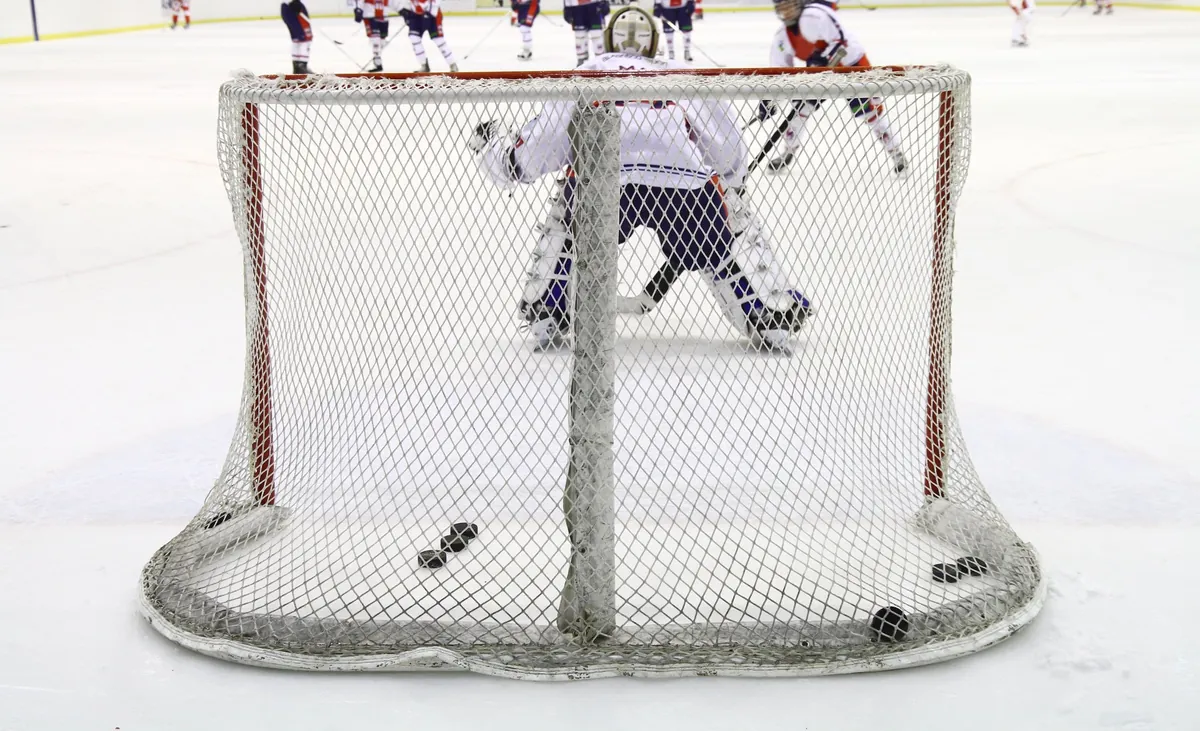
Half ice hockey drills give every player more puck touches, shots and decisions than full-ice drills, which is why Hockey Canada plays U9 on half ice and USA Hockey plays 8U cross-ice. Below: the rationale, 12 youth hockey and minor hockey drills for U9 and U11, and a 50-minute plan.
Most coaches at these ages share the ice with another team, so half ice is not a compromise. It is the right size. The drills are grouped in three themes (skating, passing, small-area games), four each, with a U9 and a U11 version.
Why half ice? The Hockey Canada and USA Hockey rules for U9
Hockey Canada: cross-ice at U7, half ice at U9
Timbits U7 plays cross-ice games with no score or standings kept. At U9, Hockey Canada's player pathway describes "a national policy ensuring all U9 hockey is played in smaller, modified spaces":
- Games are 4-on-4 plus a goalie, on a half-ice surface of at most 100 by 85 feet.
- Seven-year-olds play half ice all season. Eight-year-olds play half ice from October to December and may move to full ice on January 15 or later.
- No icing, no offside, shifts of 60 seconds recommended.
Each provincial branch, including Hockey Québec, applies the policy with its own calendar, so check your association's dates.
USA Hockey: 8U cross-ice under the ADM
USA Hockey launched its American Development Model in 2009 with cross-ice and half-ice play at the younger ages. Its 8U page sets a season of 16 to 20 cross-ice or half-ice games and 34 to 40 practices. Bob Mancini, of the ADM, calls small ice "quite simply, age appropriate."
What the numbers say
- Puck time. USA Hockey's 8U guide cites George Kingston's 1976 study, replicated by USA Hockey in 2002: in a 60-minute full-ice game, 6- to 8-year-olds averaged 20.7 seconds with the puck.
- Touches, shots and passes. Hockey Canada reports that half ice gives U9 players 2 times the puck touches, 5 times the passes received, 6 times the shot attempts and 3 times the shots on goal.
- Battles. Its small-area games guide adds 2 times the body contact and puck battles.
- Space per player. Kenny Rausch of USA Hockey calculates about 1,700 square feet per player in a full-ice 8U 5-on-5 game, against 637.5 in a cross-ice 4-on-4: "more than double the engagement and intensity level."
- Skating. Hockey Canada's guide notes that 8U players need about 65 feet to reach top speed. A cross-ice surface is 85 feet long, so they accelerate, then must turn, stop or make a play.
And at U11 (10U/Squirt)?
Games move to full ice, but practice does not have to. USA Hockey's Kenny Rausch compares cross-ice at 8U to 50-yard sprints and full ice at 10U to a 5K, and the same article reports a "3- or 4-to-1 difference" in passes and shots in 10U cross-ice games in Alaska. Small areas keep forcing decisions at every age.
Skating drills for U9 (8U/Mite) and U11 (10U/Squirt)
1. Border tag: U9 (8U/Mite) and U11 (10U/Squirt)
Setup: a line of pylons or divider pads across a third of your half; partners start on opposite sides, one is "it." Rule: "it" tries to tag the partner across the line; on a tag, roles switch. Ken Martel of USA Hockey describes the game as non-stop turns, edges, stops and starts. U9: no pucks. U11: both carry a puck.
2. Red light, green light: U9 (8U/Mite) and U11 (10U/Squirt)
Setup: players on the goal line, coach at the top of the circles. Rule: "green" is a sprint, "red" a full stop, "yellow" a glide on one foot; anyone who slides past the coach goes back. U9: T-starts and two-foot stops, the skills Hockey Canada's skating guide introduces at this age. U11: one-foot stops and backward starts.
3. Circle chase: U9 (8U/Mite) and U11 (10U/Squirt)
Setup: two players on opposite sides of a faceoff circle. Rule: on the whistle, both skate around the circle in the same direction, trying to catch the other; 20 seconds, then switch direction. U9: glide turns, outside hand on the knee. U11: crossovers with a puck.
4. Backward mirror: U9 (8U/Mite) and U11 (10U/Squirt)
Setup: partners face each other a stick length apart, in lanes marked with pylons. Rule: the leader skates forward and changes direction; the partner skates backward and stays in front. U9: backward C-cuts. U11: add a pivot to forward on the whistle, the first gap-control habit covered in our drills for defensemen.
Passing drills for U9 (8U/Mite) and U11 (10U/Squirt)
5. Partner pass and move: U9 (8U/Mite) and U11 (10U/Squirt)
Setup: pairs with one puck. Rule: count completed passes in 45 seconds, then switch to the backhand. U9: stand 5 to 10 feet apart; Hockey Canada notes those shorter passes improve accuracy and receiving. U11: pass while skating side by side across the zone.
6. Gunners' alley: U9 (8U/Mite) and U11 (10U/Squirt)
Setup: two teams behind lines facing each other, a five-gallon bucket in the middle, lots of pucks, per USA Hockey's 8U drill. Rule: shoot the bucket across the other team's line to win. U9: blue pucks, any shot. U11: every shot must come off a pass from a teammate.
7. Triangle give-and-go: U9 (8U/Mite) and U11 (10U/Squirt)
Setup: three pylons in a triangle about 15 feet apart, three players. Rule: pass, then skate to the empty pylon. U9: pass and follow your pass. U11: add a defender in the middle and play 3-on-1 keep-away; five passes in a row scores a point.
8. Crossfire box: U9 (8U/Mite) and U11 (10U/Squirt)
Setup: a box of pylons, teammates on opposite sides, two players per team inside. Rule: from USA Hockey's Cross Fire Passing Lax, a pass across the box scores one point after a pass inside, two if both inside players touch it. U9: no defenders, just pass across through the box. U11: 2-on-2 inside, as written.
Small-area games for U9 (8U/Mite) and U11 (10U/Squirt)
9. Knockout: U9 (8U/Mite) and U11 (10U/Squirt)
Setup: everyone with a puck inside a faceoff circle, one or two "thieves" without. Rule: protect your puck; a player who loses it skates around a pylon and comes straight back in, so nobody waits. Martel's coaching point: head up to read pressure. U9: one thief. U11: two or three.
10. Corner battle: U9 (8U/Mite) and U11 (10U/Squirt)
Setup: a net turned at the dot facing the corner, two lines of players forming the walls, from USA Hockey's 10U small games. Rule: the coach dumps the puck in, 1-on-1 until a goal or 30 seconds. U9: 1-on-1. U11: 2-on-2.
11. 3-on-3 in a sixth: U9 (8U/Mite) and U11 (10U/Squirt)
Setup: a third of your half (about a sixth of the sheet), two small nets. USA Hockey cites Swedish and Finnish research that 3-on-3 on one-sixth of a sheet gives the most realistic touches and shots. Rule: 45-second shifts on the whistle. U9: any goal counts. U11: two passes before a shot.
12. Net-front battle with support: U9 (8U/Mite) and U11 (10U/Squirt)
Setup: one net, two lines from the posts toward the blue line acting as walls. Rule: puck dumped in, play until a goal or 30 seconds; players in line can receive a pass and give it back. U9: 1-on-1. U11: 2-on-2, with give-and-go from the walls.
How to run a 50-minute half-ice practice
USA Hockey's 8U practice structure is built on a 50-minute block, with at least two or three stations played as games and players active "within one minute" of each rotation. Hockey Canada's U9 practice plans use the same rhythm: warm-up, stations, a fun game. On half ice with 15 to 18 players and three coaches:
| Time | Block | Drills |
|---|---|---|
| 0:00 to 0:05 | Warm-up, whole group | Red light, green light (2) |
| 0:05 to 0:13 | Station rotation 1 | Skating: circle chase (3) · Passing: triangle (7) · Game: corner battle (10) |
| 0:13 to 0:21 | Station rotation 2 | Groups move clockwise |
| 0:21 to 0:29 | Station rotation 3 | Groups move clockwise |
| 0:29 to 0:31 | Water | Coaches reset pylons |
| 0:31 to 0:45 | Game | 3-on-3 in two zones (11), 45-second shifts |
| 0:45 to 0:50 | Finisher | Gunners' alley (6) or knockout (9) |
Each station runs 7 minutes plus 1 minute to rotate. Explain each drill once, at the station, in under 30 seconds. USA Hockey also suggests running the same session twice in a row, so the second week goes to repetitions, not explanations.
Download the 12 drills as a practice PDF
Build these drills in Taggley's free drill creator, place them in the 50-minute plan and download it as a PDF, one copy for each station coach. The drill creator and practice-plan PDFs come with the free account at taggley.com, free for drills and PDFs, plus one free game of video per team.
Coach's note: At U9 and U11, one clip is enough: a goal from the weekend that started with a won corner battle shows players why drill 10 matters. Taggley's AI cuts every goal from a full game in under 40 minutes, and the coach chooses the one worth showing. For the method, see how to break down hockey game film in 15 minutes.
Frequently asked questions
Is U9 hockey played on half ice?
Yes, in Canada. Hockey Canada's national policy plays all U9 hockey in smaller spaces: half ice all season for 7-year-olds, and until at least January 15 for 8-year-olds.
Do kids still learn to play full ice if they practice on half ice?
Yes. USA Hockey's ADM moves players to full ice around 10U, and its coaches report that skills built in small areas carry over, though the benefits can take a few years to show.
What are good hockey drills for beginners?
Games beat lines. Red light, green light, border tag and knockout teach stops, edges and puck protection while every player stays active.
How many stations should a half-ice practice have?
Three stations of about 7 minutes work for 15 to 18 players and three coaches, followed by a small-area game.
Sources
- Hockey Canada, Canadian Player Pathway: U9 Hockey
- Hockey Canada, Canadian Player Pathway: Timbits U7 Hockey (abridged)
- Hockey Canada, Cross Ice Hockey: Small Area Games (Development Programs, 2020-21)
- Hockey Canada, Skating (Development Programs, 2020-21)
- Hockey Canada, U9 Program Practice Plan 28
- USA Hockey ADM, 8U
- USA Hockey ADM, Hockey Development Model 8U (guide)
- USA Hockey, 8U Basic Structure for Practice
- Michael Rand, "6U/8U: Laying the Foundation for Development" (USA Hockey ADM, November 7, 2022)
- Kenny Rausch, "8U Q-and-A: Maximizing Long-Term Development Through Cross-Ice Hockey" (USA Hockey ADM, June 25, 2019)
- Stephen Kerr, "Cross-Ice Hockey: Not Just For 8U Programs Anymore" (USA Hockey ADM, December 18, 2019)
- Michael Rand, "Three Games For Optimal Development at 8U" (USA Hockey ADM, March 27, 2019)
- Michael Rand, "What a Quality 6U/8U Program Looks Like" (USA Hockey ADM, June 8, 2021)
- USA Hockey ADM, "8U Gunners' Alley" (December 29, 2015)
- USA Hockey ADM, "10U+: Cross Fire Passing Lax" (September 1, 2018)
- Dave Pond, "Small games, big gains at 10U" (USA Hockey, November 17, 2016)