
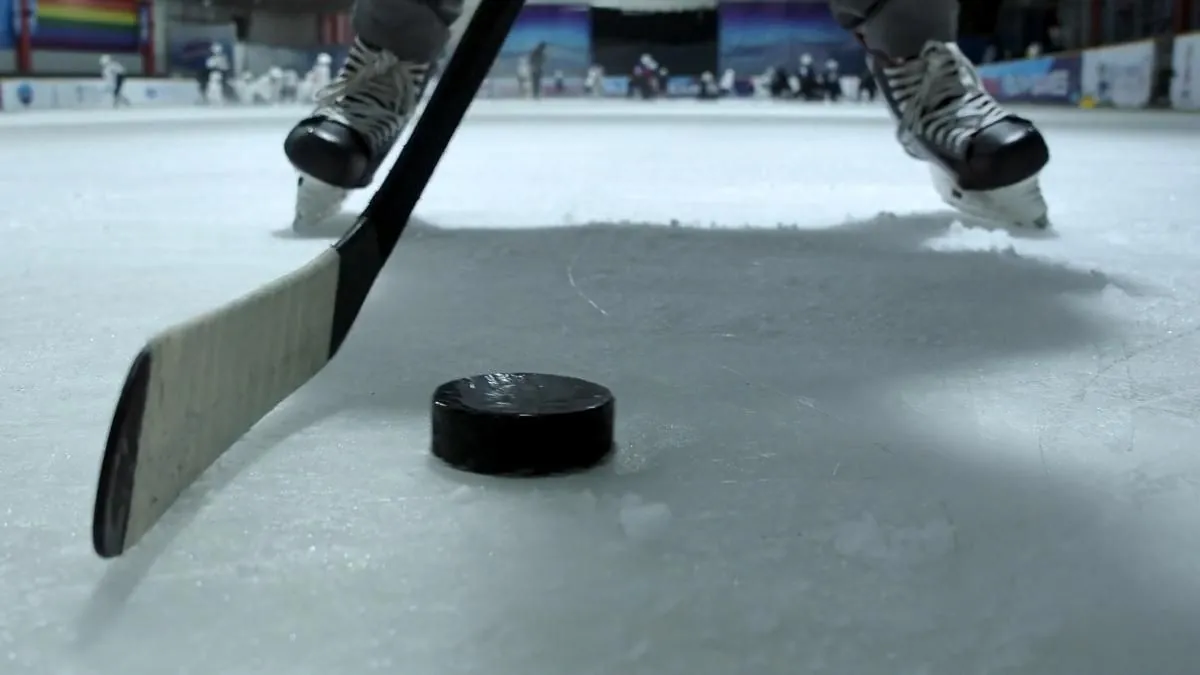
A good hockey practice plan template has a goal, a timeline and one to three teaching points per drill. A 50-minute youth hockey or minor hockey practice has five blocks: warm-up (5 minutes), skill stations (15), small-area game (10), flow drill (10), and scrimmage with wrap-up (10).
Below: what goes into the plan, the minute-by-minute table, the research, and a version for each age. The template is built in Taggley's free drill creator, where you draw each drill and export the plan as a PDF.
What a good hockey practice plan contains
Hockey Canada's Development 1 coach evaluation criteria are the clearest checklist available, because coaches are graded on them. A plan that passes has:
- A goal. One theme or a short list of key elements for the day.
- The basics. Date, time, rink, number of players and their level.
- Equipment and space. Pucks, cones, nets, and how much ice you have.
- Segments on a timeline. Introduction, warm-up, main part, cool-down and conclusion, each with its duration.
- One to three key teaching points per drill. Hockey Canada sets that number for every drill or modified game.
- Drills that are described. A diagram, a short explanation and the key points.
- Enough time per activity to actually develop the skill.
The same criteria set a standard for delivery: athletes "engaged in activity a minimum of 50% of the time." Write that number at the top of your plan: if your drills keep players in line more than half the time, fix the plan before you step on the ice.
Dave Cameron, in a Human Kinetics excerpt from Coaching Hockey With Small-Area Games, adds the step most plans skip: start from the team's needs. What did the last game show? If passing was poor, design drills with clear passing opportunities. Who is missing? With only one goalie, use the empty end for quick shots and one-timers on an open net: players get more repetitions because nobody waits for a goalie to get set.
How to build a 50-minute hockey practice, minute by minute
USA Hockey's practice planners and Hockey Canada's U9 plans are built on 60 minutes. This template uses 50, which fits most minor hockey slots once players are on the ice and leaves room for a water break.
| Time | Block | Minutes | What happens |
|---|---|---|---|
| 0:00 to 5:00 | Warm-up | 5 | A named, skill-based activity tied to the day's theme. No whistle. |
| 5:00 to 20:00 | Skill stations | 15 | Two stations of 7 minutes, 1 minute to rotate. Small groups, many repetitions. |
| 20:00 to 30:00 | Small-area game | 10 | 2-on-2 or 3-on-3 in a corner or cross-ice, with a rule that forces the day's skill. |
| 30:00 to 40:00 | Flow drill or team concept | 10 | A continuous drill: breakout, regroup, rush, or forecheck at older ages. |
| 40:00 to 48:00 | Scrimmage | 8 | Controlled game with one condition, such as every goal needs a pass first. |
| 48:00 to 50:00 | Wrap-up | 2 | One question to the players: what was today's key point? |
The warm-up: start in the first minute
Brian Gillam, on The Coaches Site, puts the cost of a slow start at about $5 a minute of ice. Saving 5 minutes per practice over 10 practices gives 50 minutes of development time. His rules: start immediately, keep everyone moving, combine skating, puck handling and decisions, and put the whistle away. Build six to eight named warm-ups and rotate them, so you can call one in the dressing room. Do the stretching off the ice: USA Hockey's 10U Practice Planner keeps the dynamic warm-up before practice to 10 minutes or less.
Skill stations: small groups, short lines
Split the ice so each group has its own space and its own coach. USA Hockey's ADM article on station drills quotes former Holy Cross coach Paul Pearl: "three stations, seven minutes each, and seven players at each station." Pearl's warning is the reason stations exist: standing in line in the corner is the easiest way to make a player stop wanting to play.
Small-area game: compete with a rule
The game teaches the skill under pressure. Pick a rule that matches the theme: two passes before a shot, or a goal only counts off a give-and-go. Keep games short.
Flow drill: put the pieces together
A continuous drill connects the skill to the game: a breakout to a rush, a regroup, a 2-on-1 back. At U13 and U15, this is the block for team concepts like the 2-1-2 forecheck.
What the research says about practice design
Games give each player very little puck time. USA Hockey's 8U parent guide cites a 1976 study in which the average young player had the puck for 20.7 seconds in a 60-minute game and took fewer than 0.5 shots. At that rate, the youngest players would need 180 games to get 60 minutes of puck possession.
Long lines waste most of the ice. Mike Bracko, writing on The Coaches Site, describes a time-motion study of 10 sessions at a summer hockey school. In a 70-minute session, one tracked player spent about 50 minutes standing in line and 10 minutes actually on task.
Smaller spaces multiply the touches. In a Finnish and Swedish study funded by the IIHF (Martin Lundby and Kalle Väliaho, 2019-2020 season), a 2-on-2 game on one-eighth of the ice produced 1.7 shot attempts per player per minute, against 0.2 in a 5-on-5 full-ice game. The authors call 5-on-5 full ice "one of the most inefficient of the game formats" for young players. One nuance: the Swedish data showed players reached their highest top speeds on full ice, so small areas don't replace every full-ice drill.
Practices matter more than games. Hockey Canada's long-term player development model sets about three practices per game for ages 9 to 12, according to the Hockey Alberta U11 pathway, and two practices per game at U15 in the Canadian Player Pathway: U15. USA Hockey's 10U planner asks for at least 2.5 practices per game.
Hockey practice plan template by age
Hockey Canada's Skills Development Program gives each age a share of practice time. Use it to fill the five blocks.
| Age | Technical skills | Individual tactics | Team tactics | Team play | Strategy |
|---|---|---|---|---|---|
| U9 (8U/Mite) | 75% | 15% | 10% | not listed | not listed |
| U11 (10U/Squirt) | 50% | 20% | 15% | 10% | 5% |
| U13 (12U/Peewee) | 45% | 25% | 10% | 10% | 10% |
| U15 (14U/Bantam) | 40% | 15% | 20% | 15% | 10% |
U9 (8U/Mite): all stations, all games
- 0 to 5: warm-up game (tag, puck races).
- 5 to 37: four stations of 7 minutes plus rotations: skating, puck control, passing, and one small game. USA Hockey's 8U guide splits the ice into six zones and rotates every 7 to 8 minutes.
- 37 to 50: cross-ice 3-on-3 games, in both ends.
- No flow drill, no systems: 75% of 50 minutes is about 37 minutes of technical skills.
U11 (10U/Squirt): add a flow drill
- 0 to 5: warm-up.
- 5 to 29: three stations of 7 minutes plus rotations (edges, passing, shooting in motion).
- 29 to 39: small-area game, 2-on-2 with a support player.
- 39 to 45: simple flow drill, such as a two-line rush to a 2-on-1.
- 45 to 50: cross-ice scrimmage.
U13 (12U/Peewee): introduce team concepts
- 0 to 5: warm-up.
- 5 to 20: two stations: 1-on-1 angling and passing under pressure.
- 20 to 30: small-area game with a transition rule.
- 30 to 42: team concept: breakout, regroup, or a first forecheck.
- 42 to 50: scrimmage with a condition, then wrap-up.
U15 (14U/Bantam): more team tactics
USA Hockey's 14U Practice Planner opens every 60-minute plan with 5 minutes of free play and a 9 to 10 minute small-area game, then stations of 7 to 8 minutes and one or two 10-minute games.
- 0 to 5: free play or warm-up.
- 5 to 13: small-area game (forecheck or backcheck game).
- 13 to 27: two stations of 7 minutes (angling, shooting).
- 27 to 40: team tactics: forecheck, breakout or special teams.
- 40 to 50: game situation scrimmage and wrap-up.
Common practice-planning mistakes
- Long explanations. Bracko suggests one to three teaching cues and a whiteboard. A five-minute talk is five minutes off the 50.
- One line, one net. Run drills from two corners and add nets.
- Conditioning first. Fatigue hurts passing and shooting: put the hard skating at the end.
- A new plan every time. USA Hockey's practice plans page suggests repeating a plan twice in a row with younger players.
Build your hockey practice plan in the free drill creator
The template on this page is built in Taggley's free drill creator, not a static download, so you can change the drills to fit your team.
- Create your free account on taggley.com. Coaches, players and parents all get one.
- Draw each drill in the drill creator, one per block: warm-up, two stations, small-area game, flow drill, scrimmage.
- Write the minutes and one to three key points next to each drill, following the table above.
- Export the plan as a PDF to print for the bench or send to your assistant coaches.
Start with the age that matches your team and change one block each week.
Coach's note: The best practice plans start from what the last game showed. Taggley's free account gives every coach the drill creator and practice plan PDFs, plus one free game of video per team, so a coach can watch one game and build the next practice from it. To review a game quickly, see how to break down hockey game film in 15 minutes.
Frequently asked questions
How long should a youth hockey practice be?
USA Hockey's sample plans and Hockey Canada's U9 plans are 60 minutes. A 50-minute plan fits most minor hockey slots and keeps every block tight.
How much of practice should players be moving?
Hockey Canada's coach evaluation sets a minimum of 50% of the time active. Stations and small-area games are the easiest way to get there.
When should team systems be in the practice plan?
Hockey Canada's skill development guidance says team play and defense should be taught at U15 and above. At U13, keep team concepts to about 10% of practice.
Is there a free hockey practice plan template?
Yes: build it in Taggley's free drill creator, then export it as a PDF.
Sources
- Hockey Canada, Development 1 coach evaluation criteria (2018)
- Hockey Canada, Skills Development Program and long-term player development
- Hockey Canada, Challenge, Learn, Improve: Skill Development (2020-21)
- Hockey Canada, Canadian Player Pathway: U15 Hockey (hosted by Hockey HNO)
- Hockey Alberta, U11 Player Pathway
- Hockey Canada, U9 Program Practice Plan, Lesson 20 (2020)
- USA Hockey, 10-and-Under Practice Planner (2019)
- USA Hockey, 14-and-Under Practice Planner (2017)
- USA Hockey, 8U Parent Guide
- USA Hockey ADM, "8U: It's Better to Have Drill Killers than Mood Killers" (August 19, 2014)
- USA Hockey, Practice Plans
- Martin Lundby and Kalle Väliaho, "Game Formats for Youth Hockey" (Finnish and Swedish Ice Hockey Associations, IIHF, 2019-2020)
- Mike Bracko, "How to Keep Players Moving in Practice" (The Coaches Site, December 29, 2023)
- Brian Gillam, "Starting Practice Effectively" (The Coaches Site, January 5, 2024)
- Dave Cameron, "Team Practice: Focus on Team Needs" (Human Kinetics excerpt, Coaching Hockey With Small-Area Games)